
How Arrest Warrants Work in Scott County
A Scott County arrest warrant starts with a sworn complaint. Virginia Code §§19.2-71 and 19.2-72 let an authorized judge, clerk, or magistrate examine that complaint and any witnesses under oath. Probable cause found, process issues. The law requires a written complaint in the situations it sets. The paper names the offense. It also directs an authorized officer to act. The magistrate or judge makes the issuing decision. Service falls to the sheriff, Gate City Police, Weber City Police, Virginia State Police, or another authorized officer working in Scott County. The clerk keeps the court file, and because each role keeps separate records, updates can arrive at different times. The Virginia process statute and probable-cause section spell out who may issue an arrest warrant and how that review works.
Scott County Arrest Warrants and Probable Cause
Who reviews the sworn facts in Scott County? A complainant gives sworn facts, and an authorized officer examines the complaint and the witnesses. That call is a legal review, not something a clerk website or a police search box makes. One extra rule matters here. Virginia law adds an authorization step before a magistrate may issue process on a felony complaint from someone outside law enforcement. Magistrate Services covers District 30. That district includes Scott, Lee, Norton, and Wise. Virginia describes magistrates as available around the clock, in person or by video. The Scott County directory lists 276-431-0146 but no public walk-in address or hours, so confirm the local channel before you travel. The official magistrate page explains probable-cause and bail duties. It offers no public warrant roster.
Scott County Arrest Warrants: What They Contain
Scott County posts no public arrest-warrant roster. Official Virginia forms show what a process and its return may contain. A public case search shows less. The full court or service file may hold more, and a bond amount can appear in a separate release order.
| Court / jurisdiction | The court that will hear the case or receive the process. |
|---|---|
| Case and offense | Case number, offense date, code section, and charge description. |
| Issuing official | Judge, clerk, or magistrate authorized to issue process. |
| Directed agency | Sheriff, police, state police, or another authorized officer. |
| Bail information | Release terms may be recorded on a separate order. |
| Execution / return | Service date, officer and agency details, and return to court. |
Use the case number printed on your own Scott County paper. No sample number stands in for it.
Scott County Arrest Warrant Form Details
What does a Scott County warrant actually contain? The Circuit Court CC-1301 form gives a reliable picture. It covers the jurisdiction, the accused, the charges, offense tracking and code fields, the case number, and bail information. Issuing authority, return date, execution details, sheriff, and administrative DNA fields round it out. One caution applies. The form explains record structure; it is not a blank application a person files to cancel a capias. A caller helps the clerk by giving the court and case number from their own document. The public CC-1301 form and instructions show those field groups. The District Court criminal forms page lists the forms used for misdemeanor process.
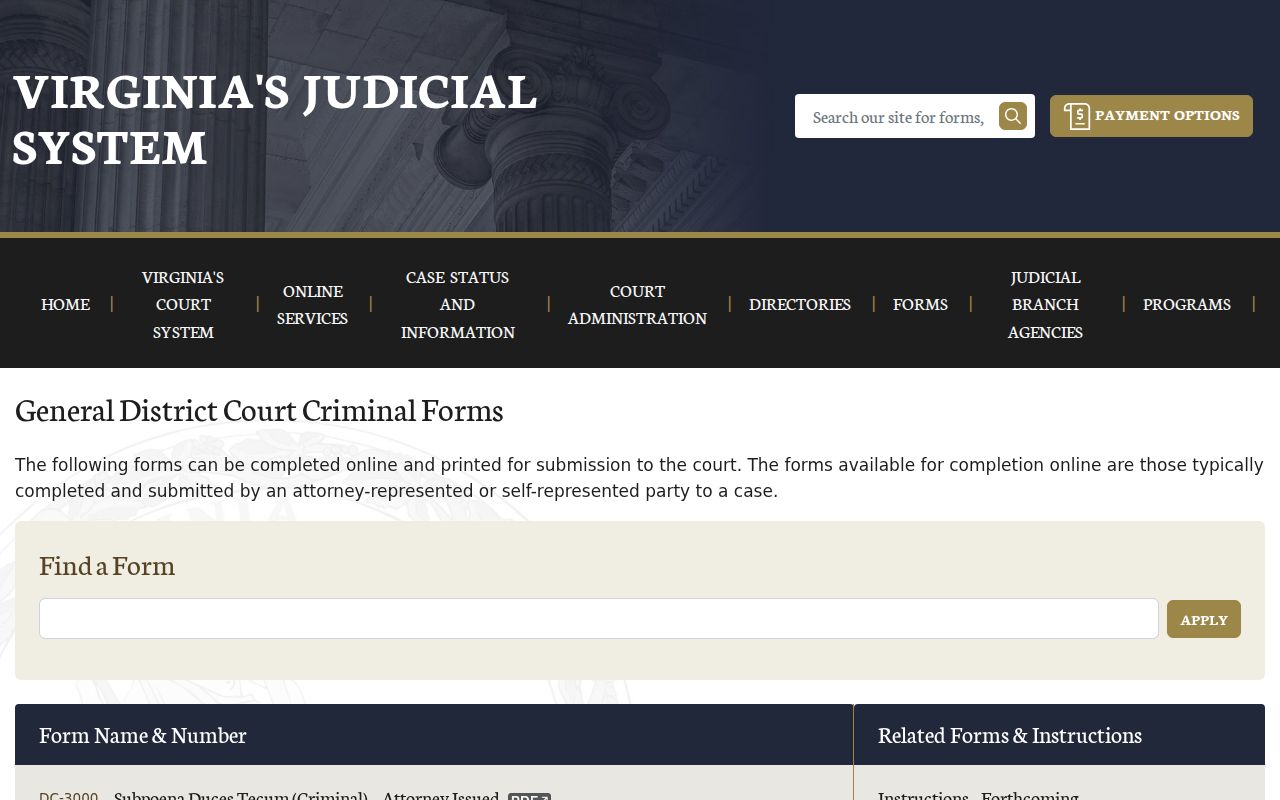
The form index supports a plain field explanation without showing any person’s record.
How Warrants Get Served in Scott County
Service is the officer's job. The court keeps the case record. Under Virginia Code § 19.2-75, the serving officer generally leaves a copy of the process with the person charged. After an arrest on a warrant or capias, § 19.2-80 requires the officer to bring the person before a judicial officer without unnecessary delay. An arrest without a warrant follows § 19.2-82. Scott County promises no fixed service timeline or bond schedule. Call the Sheriff's Office at 276-386-7679 for service routing. If Gate City or Weber City Police handled the original Scott County paper, that department may identify the agency path. Appearance and case-status questions go to the named court.
Scott Circuit Holds Felony Files
Felony files end up in Scott Circuit Court. The case may have started before a magistrate, but the felony file moves to Circuit. The Circuit Clerk sits at 202 West Jackson Street, Suite 102, in Gate City, reachable at 276-386-3801. General District Court handles adult misdemeanors, traffic matters, and preliminary proceedings. That clerk is at Suite 203, 276-386-7341. The combined court page gives its clerk and schedule. Your paper names a court. Call that clerk first, since a town police contact or the sheriff switchboard cannot replace the clerk's case-status answer in Scott County.
Arrest Warrants, Summonses, and Bench Warrants
An arrest warrant follows a probable-cause review. A summons just directs the person to appear. Ignore it and more process may follow. A bench warrant or capias usually ties back to an existing case, a missed date, or a release condition. A sealed indictment is a separate court event in Scott County and may not appear in public case information.
| Process | Scott County role | Next contact |
|---|---|---|
| Arrest warrant | Starts or advances a criminal case after sworn review | Issuing court and serving agency |
| Summons | Sets an appearance duty | Court named on the paper |
| Bench / capias | May follow a missed date or court condition | Clerk for the existing case |
The process and the court order control; a public case result in Scott County cannot settle every service or custody question.
Scott Bond Release Does Not End Case
Release on bond takes several forms in Scott County. A judge or magistrate can order a promise to appear, supervision, or a secured cash or surety bond under Virginia law. No public bond schedule exists here. Scott County also posts no Duffield bond window, so terms come from the court, not a fee chart. Getting out is only one step. The release carries conditions, and the charge plus the next court date still stand until the court says otherwise. Ask which order sets the bond, where payment is accepted, and how the clerk records compliance. A jail inmate-funds page tells you nothing about bond rules. Keep your release papers, confirm the next setting with the court, and read the Virginia release-condition statute for the judicial officer's authority.
Handling an Arrest Warrant in Your Name
Do not just show up at a Scott County sheriff's office, police department, magistrate, or regional jail. Call first and confirm which office expects you and what the court requires. Scott County publishes no walk-in surrender window, no online recall form, and no guaranteed no-arrest plan. A lawyer may arrange an appearance or a motion when the court allows it.
Get case-specific direction: Call the issuing clerk or counsel first, especially for a felony, sealed file, out-of-state process, or uncertain bond. Do not assume a clerk call changes an active order.
If police arrest you, ask for the magistrate and the release process right away. Keep the case number, bond papers, next date, and any Scott County court order that changes the warrant's status.
Scott County Arrest Process After Service
After a directed officer serves an arrest warrant in Scott County, records update at different speeds. The court file may already show the next hearing. The service return can post days later. A Scott County jail record might show release while the case itself stays open, so ask each office what it keeps and when it plans to update. For a felony file, call the Circuit Clerk; for a General District matter, call the combined clerk; for service confirmation, call the sheriff or the named police agency. One more step matters. If the court recalls or quashes the warrant, request the order or docket entry and verify the agency record caught up.